
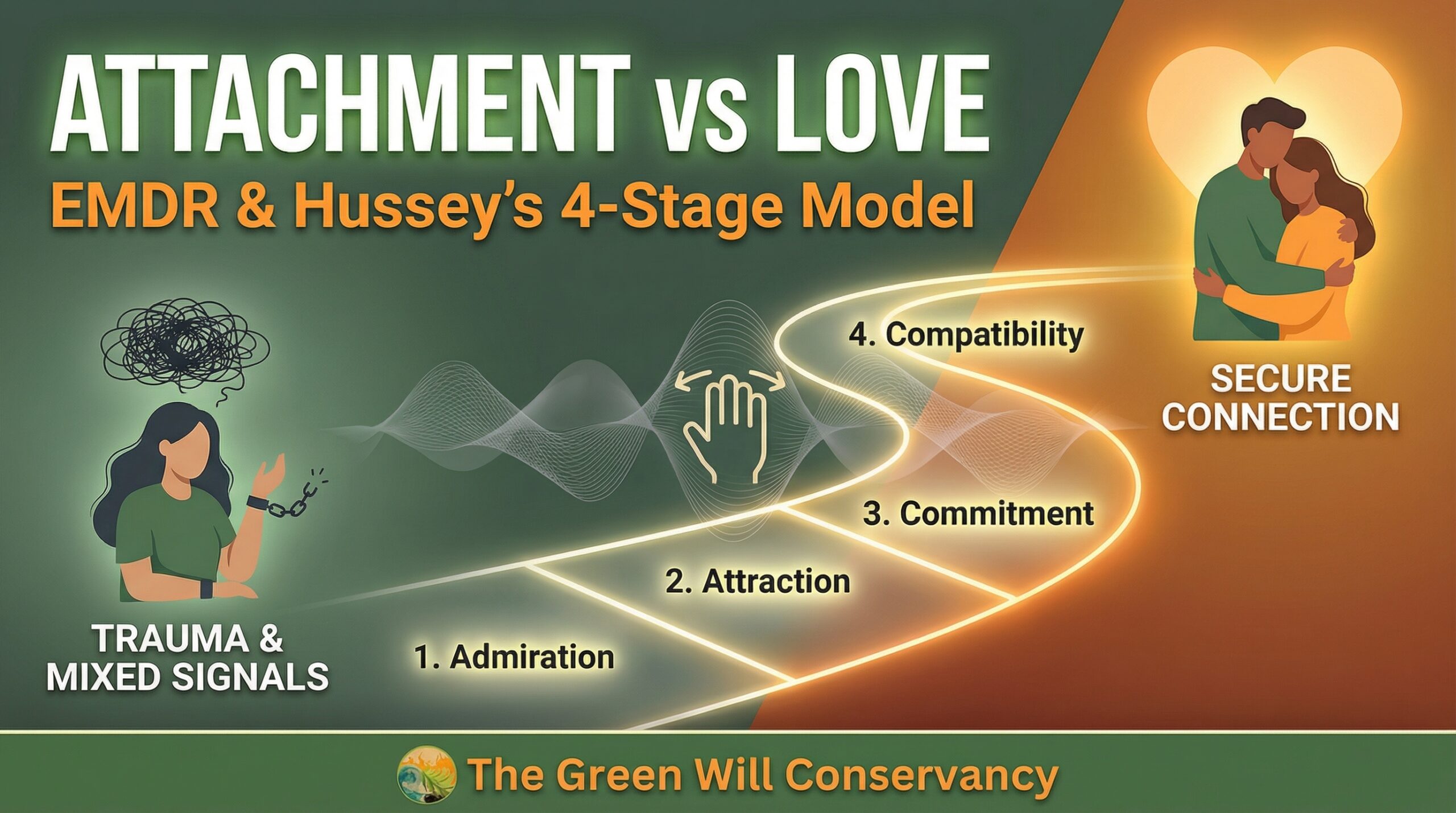
The conversation with David Kazmierczak, LCSW, offers a clear look into how attachment wounds shape trauma responses, and how EMDR clinicians can work more precisely with relational patterns while moving through the eight phases.
He opens by separating two easy-to-confuse ideas: emotional attachment versus love. Attachment is a survival pattern. It activates when fight-or-flight fails and the nervous system begins to slide toward collapse. Love is other-focused, outward, connective. Confusing those two creates mixed signals in relationships and mixed outcomes in therapy.
David connects Matt Hussey’s four relational stages to EMDR treatment:
- Admiration
- Mutual attraction
- Mutual attraction with no commitment
- Explicit agreement and compatibility
He argues that most clinical work lives in stages two and three. People present with selective perception, over-investment, limerence, and people-pleasing. Under stress, they default to old attachment cries. They soothe, but they don’t resolve.
Then David walks through each EMDR phase and shows how relational signals show up in session. Body posture changing, sliding into hypoxia, “polite” resolution, premature relief, sudden disclosures, and hovering tendencies all signal deeper attachment material. He emphasizes naming mixed signals and tracking ambivalence without forcing cognitive explanations. Clients need stability and self-trust before they can commit to difficult processing targets.
He treats relational development and trauma work as parallel processes. There is no artificial separation between the therapeutic relationship and the target material. For clinicians, the task is internal: maintain perception of relational dynamics while keeping the work grounded in the present target.
The takeaway from David’s view is straightforward. Trauma therapy is not only eye movements and target selection. It is relational hygiene, repeated boundary clarification, transparency, and steady witness. Healing requires both internal processing and external agreements. Compatibility emerges through explicit disclosure, clear commitments, and tracking ambivalence, not through intensity or attachment highs.
Kazmierczak’s framework is practical. It gives clinicians language for what they already see: mixed signals, hovering, control behaviors, selective perception, and premature collapse. It also gives clients a way to differentiate soothing from progress.
The full talk goes deeper into examples, supervision issues, and live cases. It is a functional approach for EMDR clinicians looking to integrate attachment theory and relational stages into routine trauma work.
Leave a Reply